







 Share
Share




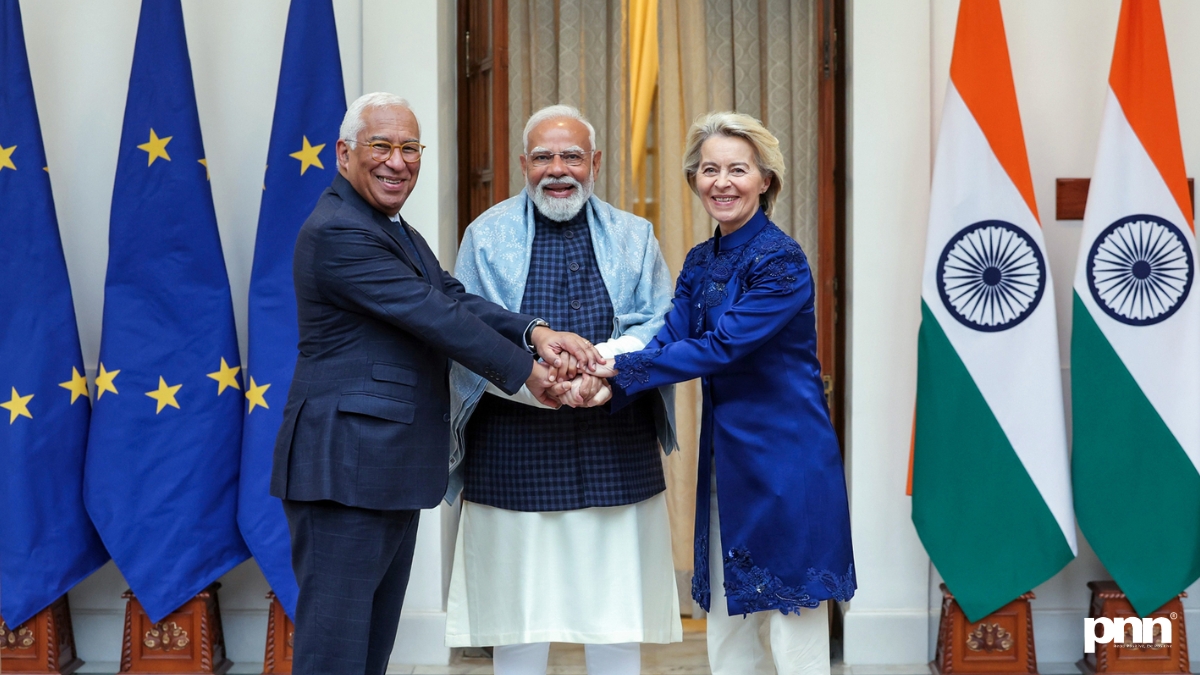
New Delhi [India], January 27: This is not another polite trade pact. The India EU Free Trade Agreement is a structural reset, unlocking Europe for Indian exporters and wiring India deeper into global value chains.
The India EU Free Trade Agreement marks a decisive shift in India’s trade strategy. After years of negotiations, India and the European Union have closed a deal that moves beyond tariffs and into trust, predictability, and scale. Two economic heavyweights. One modern, rules-based framework. And a combined market worth roughly INR 2091.6 lakh crore, or about USD 24 trillion.
For India, this is leverage. For Europe, it is reliability. For businesses on both sides, it is certainty in an uncertain world.
India and the EU together account for nearly two billion people. Yet trade between them has never matched that potential. In 2024–25, bilateral merchandise trade stood at about INR 11.5 lakh crore, with India exporting INR 6.4 lakh crore worth of goods to Europe. Services trade added another INR 7.2 lakh crore.
Healthy numbers. Still modest, considering the scale involved.
The India EU Free Trade Agreement changes the math. It delivers preferential market access for more than 99 percent of India’s exports by trade value. That is not incremental. That is transformational.
Under the agreement, India secures preferential access across 97 percent of EU tariff lines, covering 99.5 percent of export value.
Here is how that breaks down.
Over 70 percent of tariff lines, covering more than 90 percent of India’s exports, will see immediate duty elimination. This hits exactly where India needs it most: textiles, apparel, leather, footwear, tea, coffee, spices, sports goods, toys, gems and jewellery, and key marine products.
Another 20 percent of tariff lines will move to zero duty over three to five years, including processed foods, select marine products, and niche industrial items.
The remaining lines receive tariff reductions or access through tariff rate quotas, covering sensitive items like certain poultry products, preserved foods, cars, steel, and shrimp.
Translation: India wins scale without sacrificing policy space.
This is where the India EU Free Trade Agreement gets political, in a good way.
Labour-intensive sectors worth over INR 2.87 lakh crore in exports currently face EU duties ranging from 4 percent to 26 percent. Those duties drop to zero from day one.
Textiles. Leather. Footwear. Marine. Chemicals. Plastics. Toys. Gems and jewellery.
These are not just export lines. They are employment engines. The agreement sharply improves competitiveness, integrates Indian MSMEs into European value chains, and creates jobs where India actually needs them.
India is not playing defence here. Under the India EU Free Trade Agreement, India offers tariff concessions on 92.1 percent of its tariff lines, covering 97.5 percent of EU exports.
Nearly half see immediate duty elimination. Another 39.5 percent phase out over five, seven, or ten years. A small basket moves through tariff reductions or quotas, including apples, pears, peaches, and kiwi.
This approach protects sensitive sectors while allowing high-quality European technology and machinery to flow in. That means lower input costs, better consumer choice, and deeper integration into global supply chains.
Agriculture often breaks trade talks. Here, it anchors them.
The India EU Free Trade Agreement expands access for Indian tea, coffee, spices, grapes, gherkins, cucumbers, dried onion, fresh fruits, vegetables, and processed foods. This strengthens farm incomes, boosts rural livelihoods, and improves India’s positioning as a premium supplier.
At the same time, India safeguards sensitive sectors like dairy, cereals, poultry, soymeal, and select fruits and vegetables. Growth, yes. Recklessness, no.
The result is agricultural resilience, not exposure.
Preferential access means nothing without workable rules. The agreement introduces balanced product-specific rules aligned with existing supply chains.
Goods must undergo substantial processing to qualify. At the same time, exporters retain flexibility to source inputs globally. Self-certification through Statements of Origin reduces compliance costs and time.
MSMEs benefit directly. Quotas for shrimp, prawns, and downstream aluminium products allow non-originating inputs. Transition periods for machinery and aerospace incentivise Make in India without disrupting production.
Goods grab headlines. Services drive the future.
The India EU Free Trade Agreement secures deep commitments across 144 services subsectors from the EU. IT and ITeS. Professional services. Education. Business services. Digitally delivered services.
For Indian service providers, this means certainty, non-discrimination, and stable market access.
India, in return, offers commitments across 102 subsectors aligned with EU priorities, including telecom, maritime, financial, and environmental services. European firms gain predictability. Indian markets gain innovation.
This agreement does something rare. It respects people, not just products.
The India EU Free Trade Agreement establishes a clear framework for temporary entry and stay of professionals. Business visitors. Intra-corporate transferees. Contractual service suppliers. Independent professionals.
Employees of Indian companies in the EU gain easier mobility, along with their families. Independent professionals get assured access across 17 subsectors, including IT, R&D, and higher education.
There is also a roadmap for social security agreements within five years and continued openness for Indian students, including post-study work options.
An unexpected win sits quietly in the text.
In EU member states without restrictive regulations, AYUSH practitioners can offer services using Indian qualifications. The agreement locks in future openness for wellness centres and clinics and encourages deeper engagement on traditional medicine.
Soft power, meet market access.
The agreement reinforces TRIPS-consistent intellectual property protections. It recognises India’s Traditional Knowledge Digital Library. It affirms the Doha Declaration. It supports technology transfer and information sharing.
On SPS and TBT measures, enhanced cooperation enables equivalence, faster conformity assessment, digitised processes, and predictable regulation. Fewer surprises. Faster clearance. Safer trade.
Engineering goods gain preferential access against EU tariffs of up to 22 percent, expanding India’s INR 1.44 lakh crore export base.
Leather and footwear exports drop from tariffs as high as 17 percent to zero, opening a USD 100 billion EU market.
Marine exports gain full preferential access, turbo-charging shrimp and seafood shipments and strengthening coastal economies.
Medical devices see duties of up to 6.7 percent eliminated across nearly all trade lines.
Gems and jewellery gain full access across a USD 79 billion import market.
Textiles and apparel secure zero-duty access into a USD 263 billion market.
Plastics, rubber, chemicals, minerals, furniture, home décor. All see meaningful gains. All feed jobs. All reward scale.
The India EU Free Trade Agreement is the rare deal that balances ambition with discipline. It opens markets without hollowing domestic priorities. It favours jobs over optics and certainty over slogans. India did not trade away leverage. It converted it into access, mobility, and scale. This agreement will not deliver overnight miracles, but it quietly hardwires India into Europe’s economic future.